
Blog
When Outlook goes silent: e-mail and rescue for emergencies
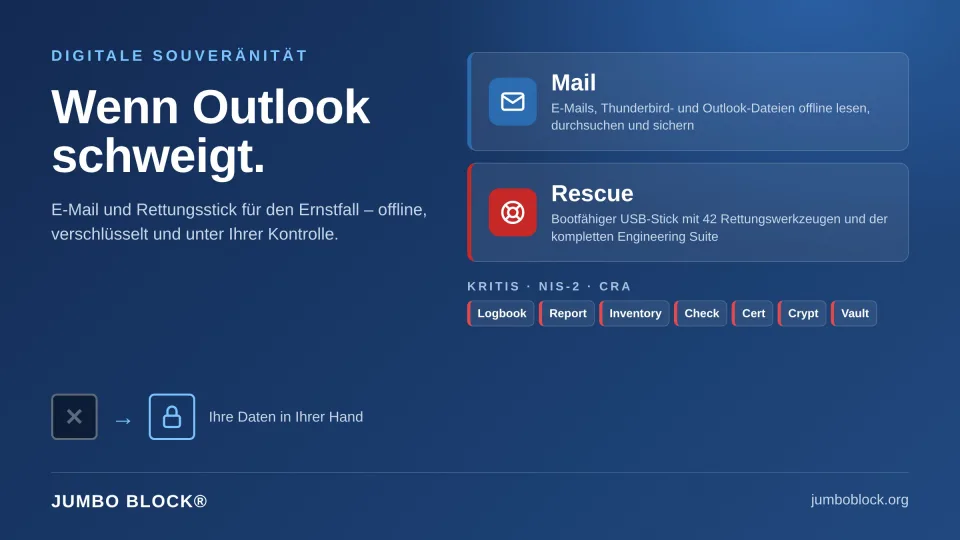
Three Microsoft outages in just over two months show how dependent businesses are on a single provider. With JUMBO BLOCK Mail and JUMBO BLOCK Rescue, two new tools are now available on jumboblock.org that keep your data and your ability to work in your hands.
Three outages in just over two months
On the evening of 31 August 2026, Outlook went down worldwide. Sign-in, sending and receiving were disrupted, affecting Microsoft 365 business customers and private users alike. According to Microsoft, the cause was a fault in a central component of Exchange Online.
Next, companies running Exchange themselves were hit: after the October Windows Server updates, e-mails got stuck in the outbox and sign-ins via Outlook on the web failed. This is only fixed with the November updates.
Since 5 November, e-mails to Outlook.com and Hotmail addresses have been partly rejected. Recipients do not notice, and senders often only find out when someone asks.
What if it lasts for weeks?
The major outage in August lasted hours. Just imagine it had lasted weeks: offers, orders, coordination with authorities – most of it runs by e-mail. If that one provider fails, not one company comes to a standstill, but thousands at the same time.
For operators of critical facilities, this is not a theoretical question. Germany’s KRITIS Umbrella Act and NIS-2 require precautions for business continuity and recovery. Anyone who entrusts all of their communication to a single service has a gap right there.
JUMBO BLOCK Mail: your e-mails in your hands
JUMBO BLOCK Mail is an e-mail program for outages. It runs in the browser, locally and without a user account:
- Read and back up offline: read, search and back up e-mail files (.eml, .mbox), Thunderbird mailboxes, Maildir folders and Outlook files (.msg, .pst, .ost) – without Outlook
- Send and receive: via IMAP and SMTP with the local bridge jb-mail.py or the server bridge jb-mail.php on your own web server
- Security: S/MIME for signing, encrypting and verifying, phishing warnings, safe display of HTML e-mails
- Crisis team: hand over an e-mail to the situation log JUMBO BLOCK Logbook
To be honest: Mail also needs a mail server for sending and receiving. Full sovereignty only comes together with your own or an independent server. But your mailboxes and archives stay readable and searchable, whatever happens in the cloud. And the code is open in the browser – anyone can check what it does.
JUMBO BLOCK Rescue: operational when nothing starts anymore
JUMBO BLOCK Rescue is a bootable rescue and work system on a USB stick. It starts a clean Linux system independently of the installed operating system – after a cyberattack, during a system failure or for data recovery. On board are 42 rescue tools and the complete JUMBO BLOCK Engineering Suite, Mail included. The image is available on request; the download uses a personal code.
Part of the KRITIS tools
Mail and Rescue complement the tools for emergencies on jumboblock.org: situation log (Logbook), reporting obligations (Report), device and network register (Inventory), checksums (Check), your own certificates (Cert), encryption (Crypt) and password vault (Vault). All of them run offline and encrypted.
It takes some getting used to at first. In return, it gives you back something many have long since handed over: full control over your data.
All programs and manuals are available on jumboblock.org. Questions and requests for Rescue: mail@jumboblock.de.
Sources (German): dpa-AFX, 31 Aug 2026 · BornCity, 11 Nov 2026 · t3n, 9 Nov 2026