
Technical data & structure
Data sheet and structural behaviour
A modular reinforced-concrete structure that acts as one continuous system once installed. Here you will find all key data and the basis of structural design.
Updated:

Data sheet
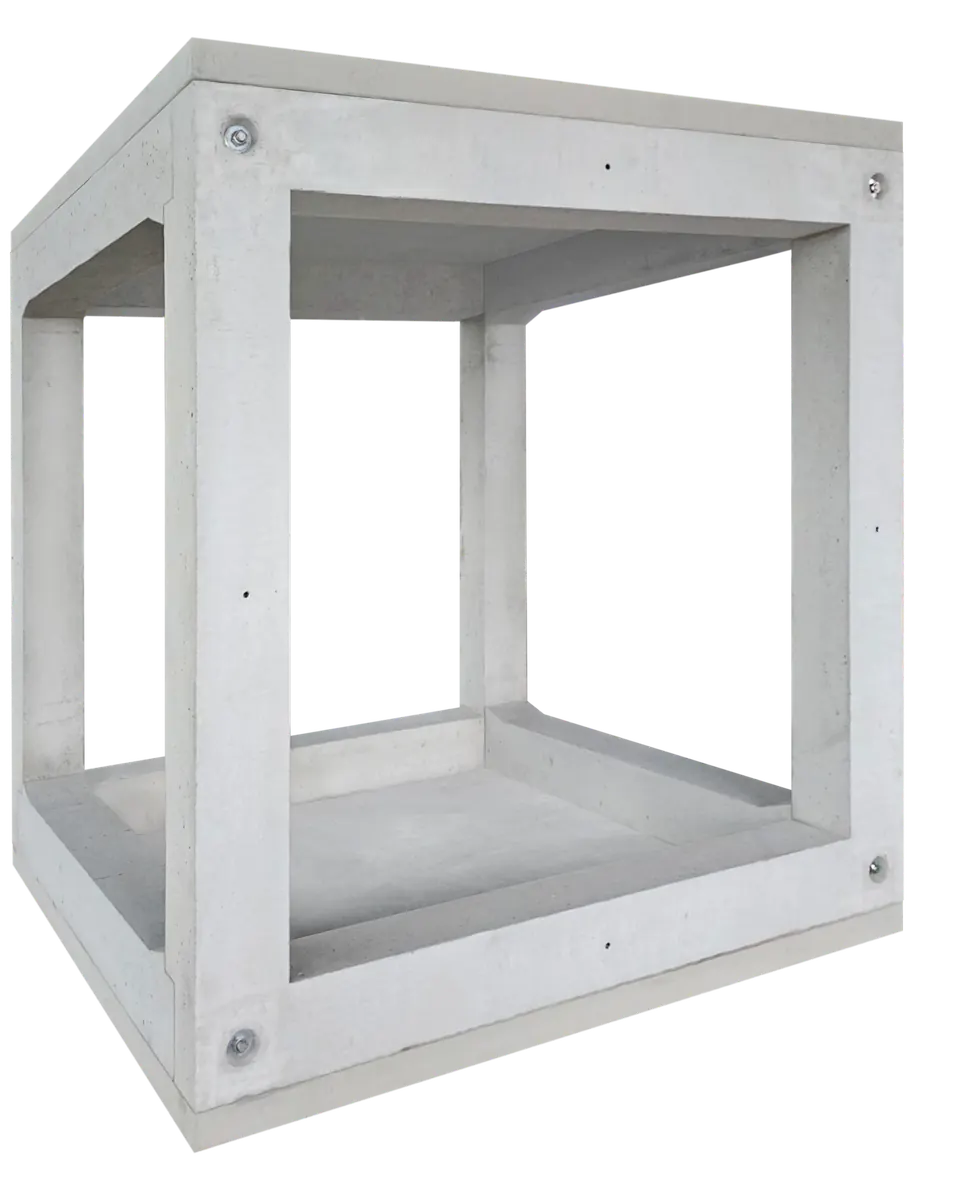
| Outer dimensions (L × W × H) | 2.5 m × 2.5 m × 2.5 m |
|---|---|
| Clear width (L × W) | 2.0 m × 2.0 m |
| Room height | 2.5 m (floor plate to cover plate) |
| Gross volume | 15.6 m³ |
| Storage volume (net) | 13.9 m³ |
| Storage per m² of footprint | approx. 2,224 l per m² of footprint |
| Dead weight (dry) | approx. 4.2 t |
| Load-bearing structure | 12 beams, cross-section 0.25 m × 0.25 m |
| Material | High-performance concrete |
| Concrete strength class | C40/50 (standard); up to C80/95 for bunkers and protective structures |
| Reinforcement | Steel, fibre or hybrid reinforcement |
| Plate thickness | from 120 mm |
| Load capacity | Traffic load to EN 1991-2, load model LM1 |
| Design service life | 80–120 years to EN 1990 |
| Installation pattern | single layer, each module rotated by 90° |
| Sealing | SABA EcoSeal |
Functions
- Storage and retention of rain, flood, process and fire water
- Optional infiltration via strip foundations
- Optional integrated sedimentation and filtration systems
- Suitable for heavy-duty areas with high loads
- Modular, extendable and adaptable to projects
Installation and maintenance
- Laid directly on a prepared, load-bearing subgrade
- Covered with plates, road pavement or soil
- Fixing loose, bolted or bonded – depending on the application
- Access via inspection openings (optional)
Areas of use
Road construction and trafficked areas, urban development and flood protection, industry and logistics, airports, fire-water storage, renaturation and water management.
Structural behaviour
One structure instead of many parts
JUMBO BLOCK is not a single component but a modular reinforced-concrete system. The modules are placed flush, each rotated by 90°, and connected directly to each other. This creates a continuous, force-locked structure.
Load distribution instead of point loads: traffic loads are introduced into the system via the road build-up – with or without soil cover – and the cover plates. Several modules are activated at once and local stress peaks are reduced. Columns and beams with a 25 cm × 25 cm cross-section transfer the loads into the subsoil.
Redundancy: because the modules act together, the installation has high load reserves and is insensitive to unforeseen local overloads.

Design
Verified like cast-in-place concrete
In its final state, the system acts like a single-layer reinforced-concrete structure. Structural design is carried out for each project to the European standards:
EN 1990
Basis of structural design, service life
EN 1991
Actions on structures, traffic loads to EN 1991-2 (LM1)
EN 1992
Design of reinforced-concrete structures
EN 1997
Geotechnical design and foundations
Clear separation of structure and sealing
The concrete structure carries the loads, the sealing system provides watertightness. This separation simplifies structural calculation and approval, because the structure can be verified like a conventional reinforced-concrete construction.
Structural analysis on request: JUMBO BLOCK Static
We prepare structural calculations with JUMBO BLOCK Static on request from your project file from Plan or Budget. The tool delivers traceable results within minutes – from a single module to installations with several hundred modules.
FAQ
Frequently asked questions
What loads can JUMBO BLOCK carry?
The system is designed for traffic loads to EN 1991-2, load model LM1 – i.e. road traffic including heavy goods vehicles. Structural design is carried out for each project individually.
Which standards is JUMBO BLOCK designed to?
EN 1990 (basis of structural design), EN 1991 (actions), EN 1992 (concrete structures) and EN 1997 (geotechnics), each with the national annexes.
How long does a JUMBO BLOCK last?
The modules are designed for a service life of 80 to 120 years to EN 1990.
Are JUMBO BLOCK modules stacked?
No. Installations are always single-layer. Modules are lined up side by side and one behind the other, each rotated by 90°.
Read on
Components
Modules, plates and sealing with guide prices.
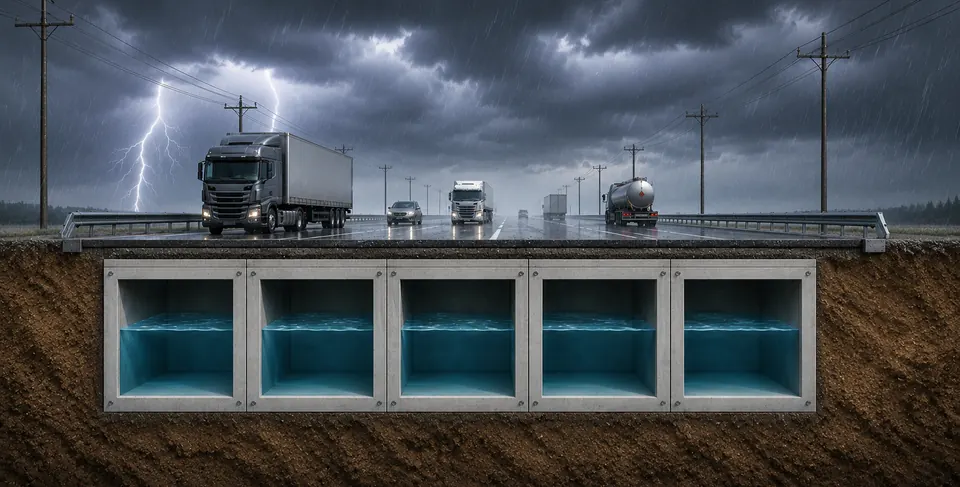
Roads & transport infrastructure
Retention integrated into the road structure.
Downloads
Data sheets and technical documents.