
Blog
Plastic Crates or Heavy-Duty Concrete?
Stormwater retention systems in a tough practical comparison
The requirements for modern stormwater management have tightened drastically: local heavy-rain events are measurably increasing in intensity and frequency, while inner-city areas are becoming ever more densely built up and sealed. Planners, municipalities and civil engineers today face the urgent task of creating huge retention volumes underground and in a space-saving way.
At first glance, many contractors reach for the widely used plastic box or block crates. They are light and quick to assemble. But in tough everyday practice – and above all when infrastructure projects are viewed over the long term – this supposedly easy route reveals serious weaknesses.
This direct system comparison shows why JUMBO BLOCK, as a modular concrete system, is the technologically, economically and ecologically superior answer to classic plastic crates.
1. Structure and load capacity: real heavy-duty performance vs. settlement risk in the asphalt
An underground retention system must not be a weak point in the ground. The areas above often have to be used for several purposes – as car parks, fire-brigade access routes or logistics areas.
- The plastic problem: by design, plastic crates have narrow structural limits. Because they are flexible and yield under pressure, heavy lorry traffic requires either a very deep soil cover or elaborate special constructions at shallow installation depths. The decisive cost driver in civil engineering, however, is the immense effort for soil replacement and the precise, layer-by-layer compaction of the surrounding soil with special base-course material. If this is not done perfectly, dangerous settlement and cracks in the asphalt can follow later.
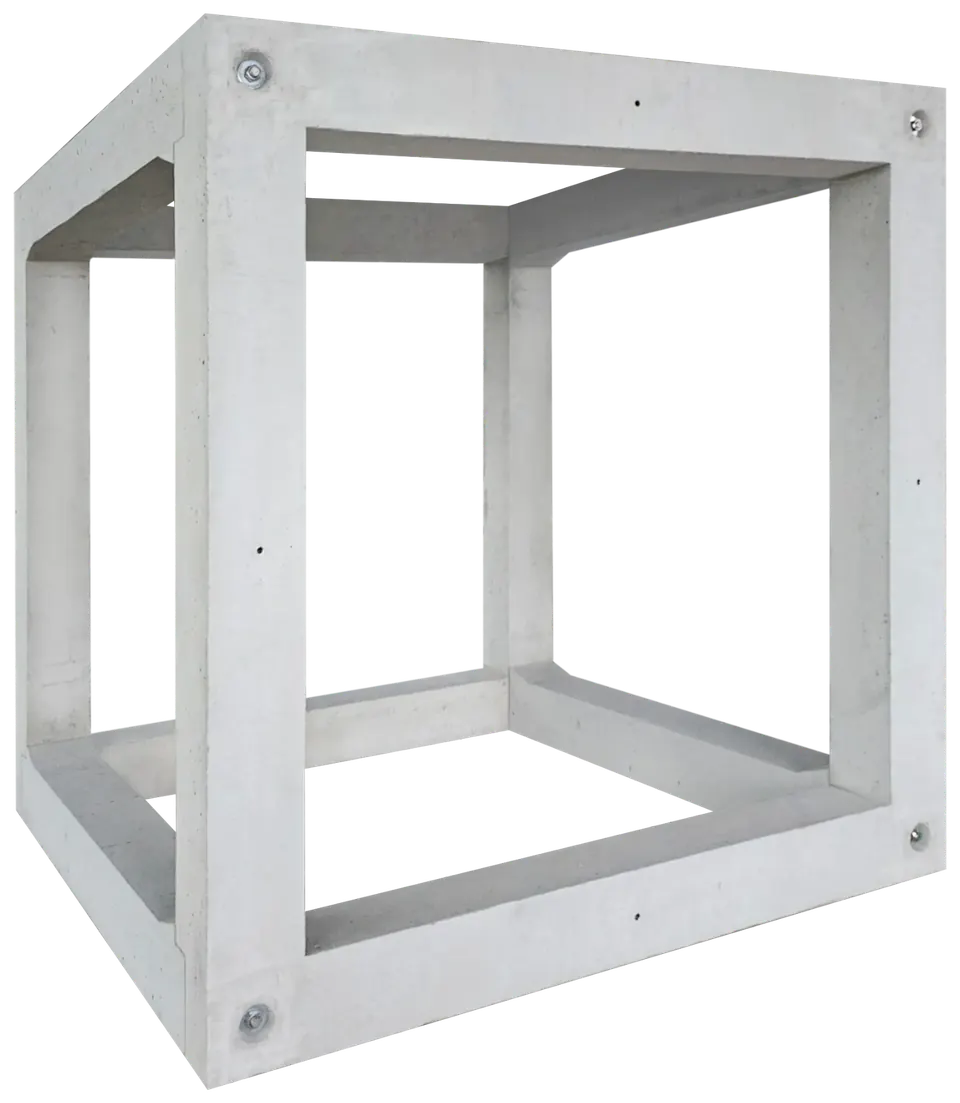
- The JUMBO BLOCK solution: the system brings its own robust structure with it. With a solid column cross-section of 25 cm × 25 cm in the skeleton construction, the structure stands firm. JUMBO BLOCK absorbs horizontal and vertical earth and traffic loads by itself. The system meets demanding structural requirements under the current Eurocode (load model 1 / LM1, formerly SLW 60 in Germany) right from installation and drastically reduces the effort for soil replacement and securing the excavation.
2. Flexibility and volume: free scaling on a single level
Large infrastructure projects often have to buffer immense amounts of water within a very short time. Assembling thousands of delicate plastic parts is extremely time-consuming in civil engineering.
- The plastic problem: to achieve large volumes, plastic crates have to be either stacked deep (which aggravates the earth-pressure problem) or spread over a wide area. This severely limits adaptation to irregular plot boundaries or existing utility routes in the ground.
- The JUMBO BLOCK solution: JUMBO BLOCK relies on maximum efficiency through sheer size. A single module already measures 2.5 m high, 2.5 m deep and 2.5 m wide. Installation is safe and straightforward on a single level. Because practically any number of modules can be lined up, even very large retention volumes are realised quickly. The system is also highly flexible: on the 2.5 m grid, almost any plan shape can be assembled to make optimal use of the space available underground.
3. Service life: replacement risk vs. 80–120 years of investment security
Infrastructure projects and facilities related to critical infrastructure are not built for the next decade but for generations.
- The plastic problem: petrochemical plastics age underground. Temperature changes and environmental influences make them brittle. In addition, the release of microplastics into sensitive near-surface groundwater is increasingly in the focus of environmental authorities and stricter regulation.
- The JUMBO BLOCK solution: concrete is a mineral, extremely durable building material. JUMBO BLOCK modules are designed for a service life of 80 to 120 years. The system releases no microplastics into soil and groundwater and gives municipalities and investors security for generations.
4. Maintenance, inspection and lasting function
A retention system that cannot be maintained inevitably silts up with sediment and loses retention volume over the years.
- The plastic problem: many plastic honeycomb structures are barely accessible, even with modern flushing and camera robots. Once the system is silted up, its function is permanently impaired. Replacing it beneath an asphalted traffic area means total economic loss.
- The JUMBO BLOCK solution: thanks to the generous module height of 2.5 metres, the modular concrete structure is not only a retention space but a real, walk-in structure. The system is spacious, walk-in and accessible for vehicles. Sediment can easily be removed by high-pressure flushing. This preserves full performance over the entire service life of 80 to 120 years.
Conclusion: economic efficiency in a life-cycle cost comparison
Anyone who compares only the pure material purchase costs may choose the plastic crate. But anyone who draws up a full cost calculation (life-cycle costs) cannot ignore concrete.
If you include the extra effort of assembling hundreds of plastic parts, the intensive soil replacement and elaborate compaction, the risk of settlement in the asphalt and, above all, the considerably longer service life, JUMBO BLOCK is the most economical and safest system on the market. It makes stormwater infrastructure permanently future-proof and KRITIS-ready.
Are you planning a stormwater retention project beneath heavy-duty or traffic areas to LM1? Use the flexibility of geometric shapes and the free scalability of our system on a single level. Save on expensive auxiliary structures and rely on the generational security of concrete.
Get in touch now & request a project