
Stormwater retention
Stormwater retention with JUMBO BLOCK
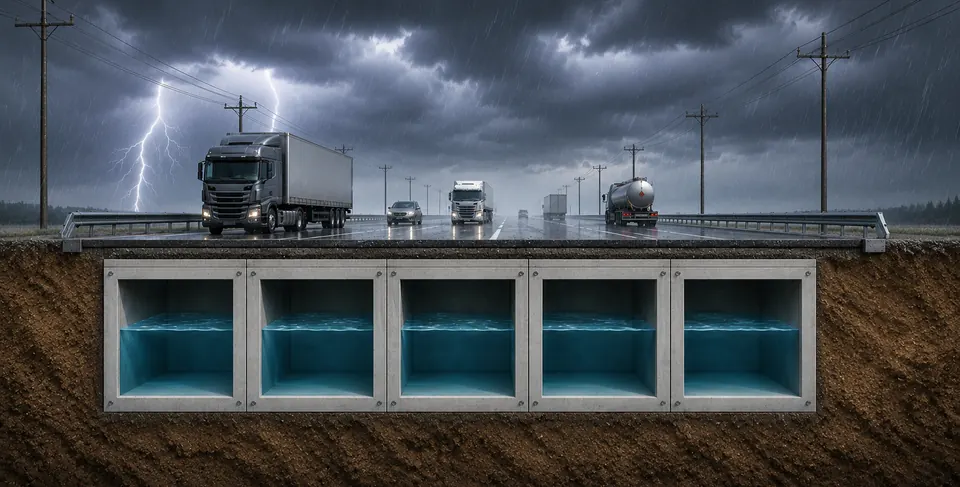
During heavy rain, the sewer cannot drain water as fast as it runs off sealed surfaces. A retention space made of JUMBO BLOCK modules absorbs the peak beneath roads, car parks and yards and releases the water at a throttled rate. The surface above remains fully usable.
Updated:
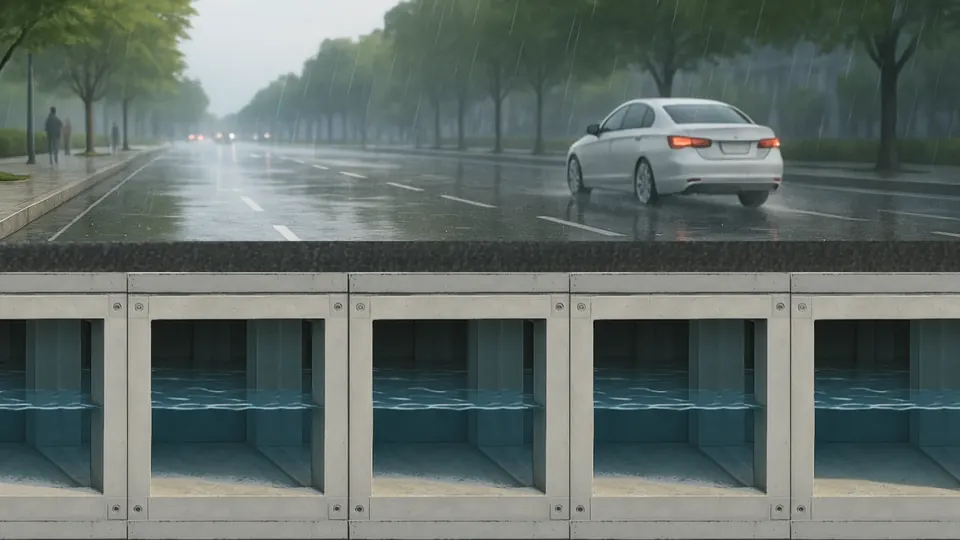
How it works
How a retention space works
The principle is simple: water is not drained immediately but stored temporarily and released later. What matters is that the storage is large enough, stays watertight and does not take away the surface above.
- 01
Inflow
Rainwater from roofs, roads and yards flows through gutters, chambers and a sand trap into the storage.
- 02
Store
The JUMBO BLOCK modules absorb the peak. Each module holds 13.9 m³, and the volume grows with the number of modules.
- 03
Throttled discharge
A flow throttle releases only as much water as the sewer or receiving water can handle. The permitted discharge is set by the municipality or water authority.
- 04
Ready for the next rain
After the event the storage empties. Part of the water can also be kept for irrigation or fire fighting.
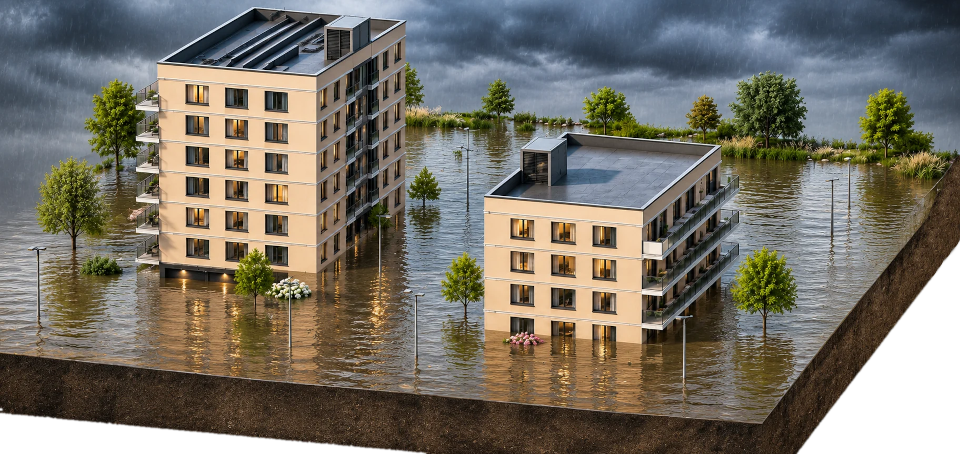
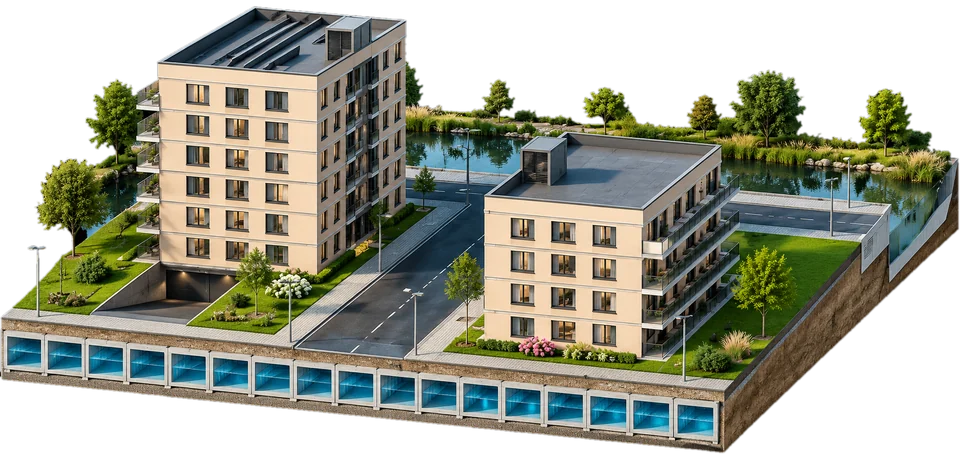
Visualisation: buildings, street and modules modelled and rendered in FreeCAD, refined in Blender; trees, planting and water added with AI.
Sizing
How large does the storage need to be?
The required retention volume follows from the connected area, its surface type, the local design rainfall and the permitted throttled discharge. In Germany, sizing follows DWA-A 117 with rainfall data from KOSTRA-DWD-2020. The number of modules follows from the volume.
| Modules | Usable volume | Footprint |
|---|---|---|
| 4 | 55.6 m³ | 25.00 m² |
| 8 | 111.2 m³ | 50.00 m² |
| 12 | 166.8 m³ | 75.00 m² |
| 20 | 278.0 m³ | 125.00 m² |
| 40 | 556.0 m³ | 250.00 m² |
| 80 | 1,112.0 m³ | 500.00 m² |
The modules can be arranged on the 2.5 m grid into almost any footprint. For a first estimate, Hydro on jumboblock.org calculates the volume to DWA-A 117, Plan lays out the modules and Budget estimates the costs – free of charge and without installation. About the Engineering Suite →
Construction
Construction of a retention installation
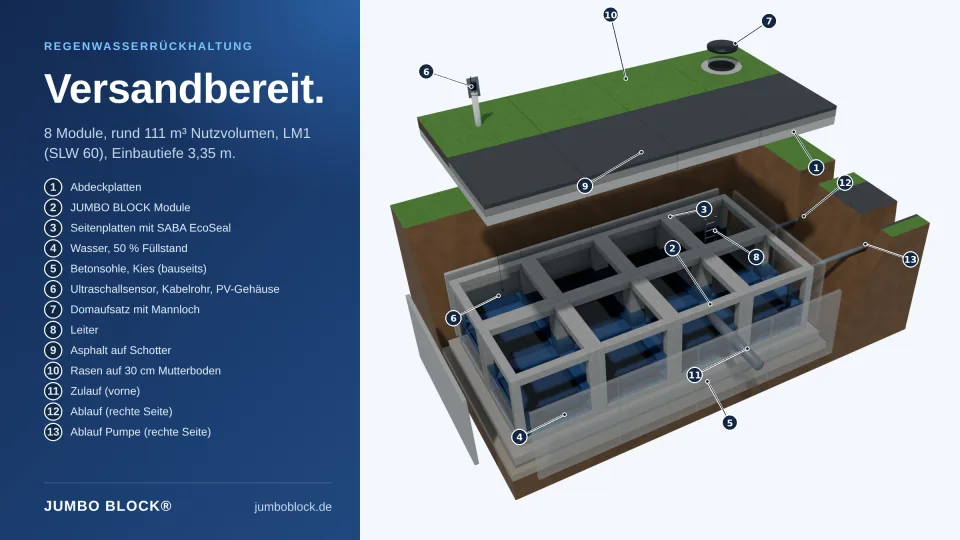
The installation is built from the bottom up. The modules stand in a single layer on the foundation, each rotated by 90° relative to its neighbour. This creates one continuous load-bearing structure.
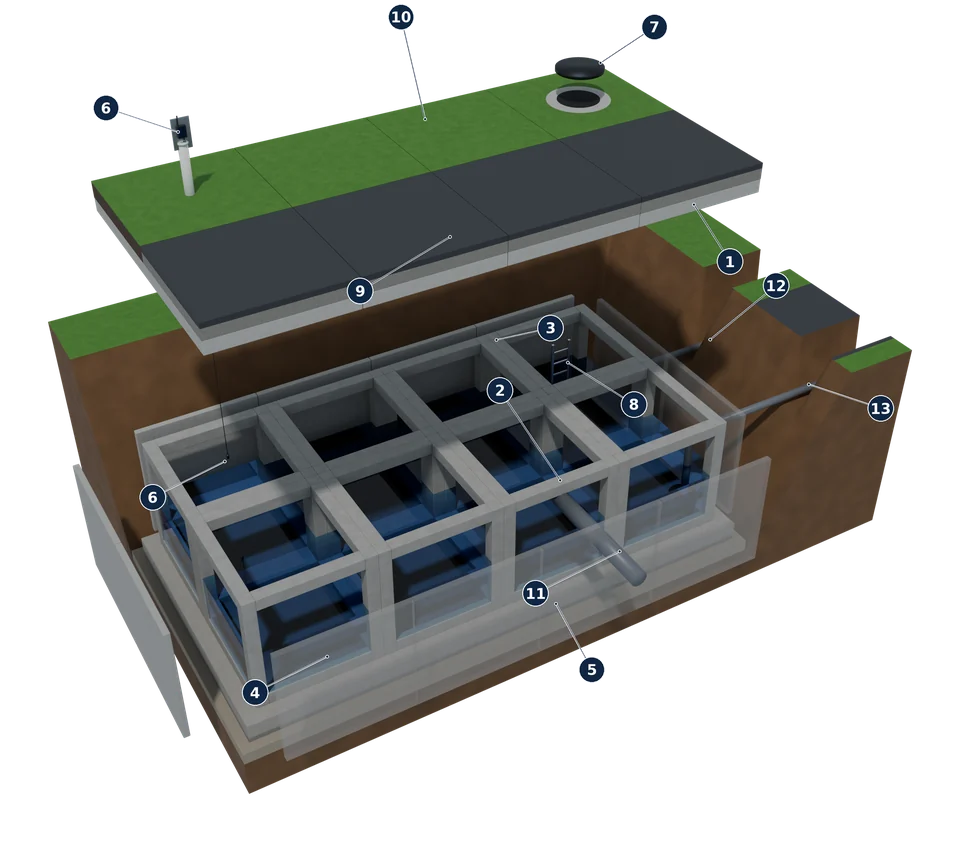
- Cover plates close the installation at the top.
- JUMBO BLOCK modules form the load-bearing structure.
- Side plates are bonded to the blocks and sealed with SABA EcoSeal.
- Water in the retention space, here at 50 % fill level.
- Concrete base slab on blinding layer and gravel.
- Ultrasonic sensor flush with the top of the modules, connected by cable to the solar housing above ground.
- Access dome with manhole and cover.
- Ladder into the installation.
- Asphalt on crushed stone above the front row of plates, trafficable to LM1.
- Lawn on topsoil above the rear row.
- Inlet from the front.
- Outlet to the flow throttle, right side.
- Pump outlet from the pump sump, right side.
Sealing uses SABA EcoSeal – environmentally friendly and suitable for drinking water – between block and side plate and between block and base slab. This makes the installation completely watertight. All components →
Key figures
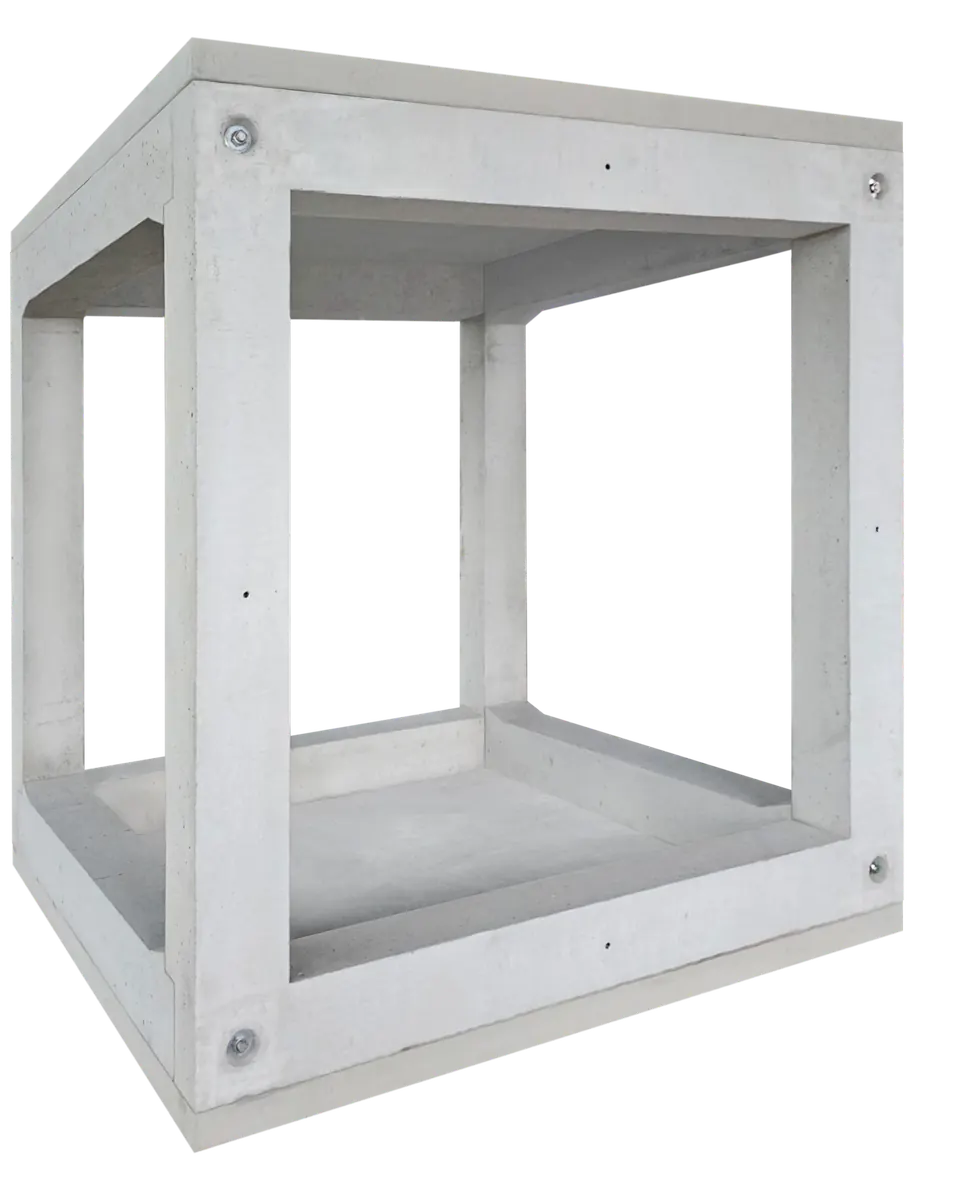
The module for retention
| Storage volume (net) | 13.9 m³ |
|---|---|
| Gross volume | 15.6 m³ |
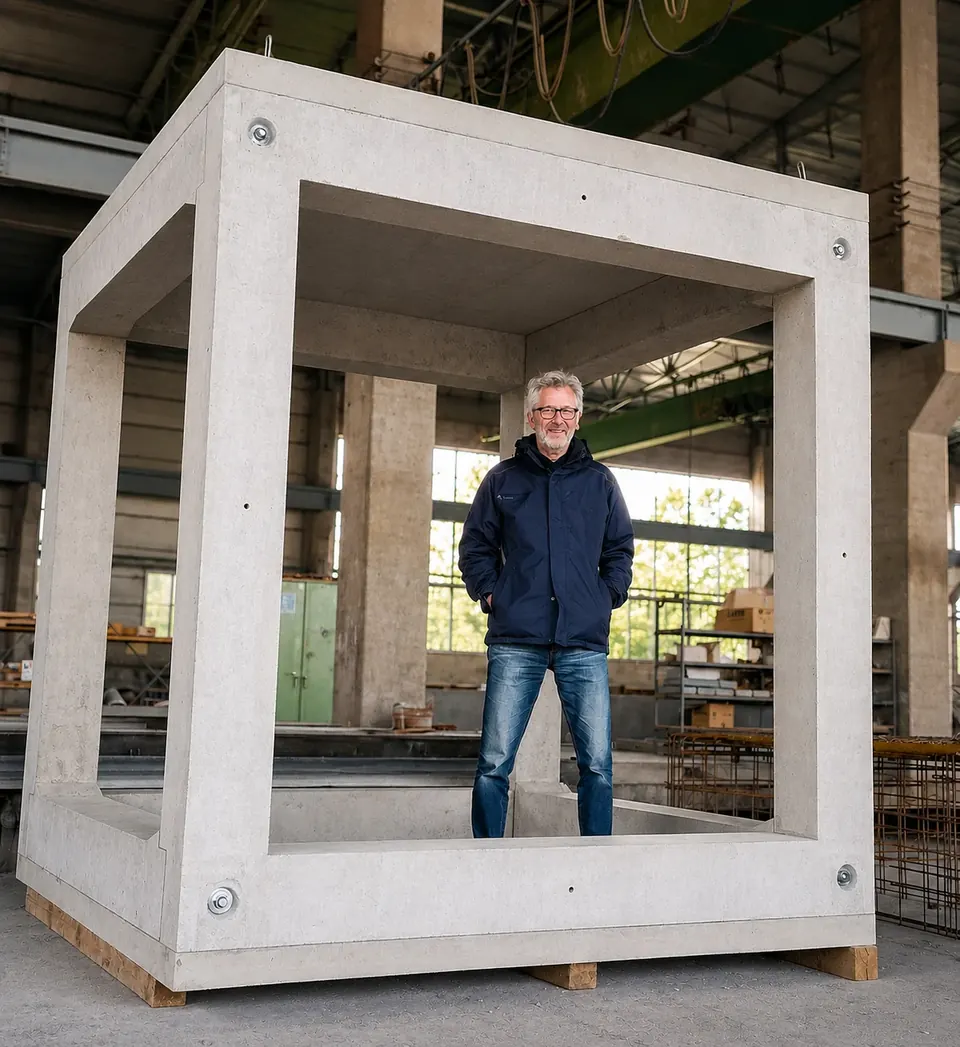
| Outer dimensions (L × W × H) | 2.5 m × 2.5 m × 2.5 m |
| Clear width (L × W) | 2.0 m × 2.0 m |
| Storage per m² of footprint | approx. 2,224 l per m² of footprint |
| Load capacity | Traffic load to EN 1991-2, load model LM1 |
| Sealing | SABA EcoSeal |
| Design service life | 80–120 years to EN 1990 |
| Installation pattern | single layer, each module rotated by 90° |
Comparison
Which solution for which task?
There are several proven designs for stormwater retention. Which one fits depends on volume, available area, loads and maintenance.
Open retention basin
Simple and inexpensive, but needs a large surface area – which is usually lacking in towns and on industrial sites.
Plastic crate systems
Light and quick to assemble. Under heavy traffic and with shallow cover, however, structural reserves are limited, and many systems can only be inspected to a limited extent.
Tanks and storage sewers
Proven for small to medium volumes. The size per unit is limited by transport or pipe diameter.
JUMBO BLOCK
Large-volume, single-layer and freely extendable, trafficable to LM1, walk-in and maintainable. The surface above remains fully usable.
Detailed comparison: plastic crates or heavy-duty concrete? →
Monitoring
Fill level in real time, verifiable
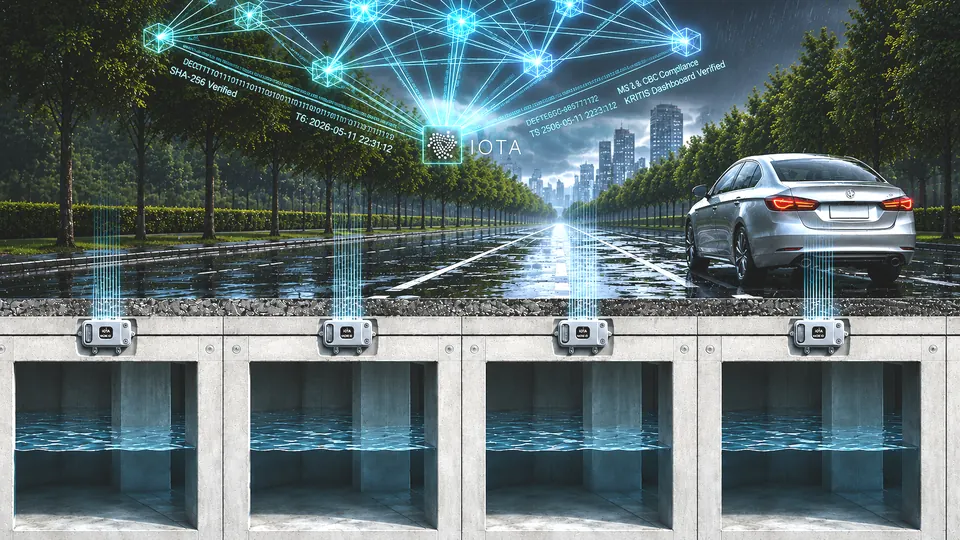
A LoRaWAN ultrasonic sensor measures the fill level. The readings flow into the JUMBO BLOCK Dashboard, and an integrity proof is anchored on IOTA. Every reading stays verifiable – for operators, supervisors and, where required, under KRITIS and NIS-2.
KRITIS · NIS-2 · CRA
KRITIS-ready: the structure for physical resilience
The German KRITIS umbrella act requires operators of critical facilities to implement physical resilience measures, including against extreme weather. For water utilities, municipal utilities, data centres, hospitals, ports and industry, flood-proof stormwater retention therefore becomes part of the obligation. JUMBO BLOCK is the structure with which this requirement can be implemented and evidenced.
Physical: KRITIS umbrella act
Retention space against heavy rain and flooding, trafficable to LM1, fully sealed, designed for 80–120 years. Walk-in for inspection and maintenance.
Digital: NIS-2
Real-time fill level in the JUMBO BLOCK Dashboard, alerts at thresholds and reliable data for the 24 and 72-hour reporting deadlines.
Evidence: CRA-ready
Integrity proof for every reading on IOTA, openly verifiable software and documentation for the BBK, BSI and supervisory authorities.
Whether a facility meets all legal obligations depends on the operator's overall concept. JUMBO BLOCK provides the structure, the monitoring and the evidence for it. Duties and deadlines at a glance →
In practice
Projects and articles on retention
Ready to ship: 8 JUMBO BLOCK modules for rainwater retention
About 111 m³ of usable volume, trafficable to LM1 (SLW 60), sealed with SABA EcoSeal, sensors ready. Now we are waiting for the excavation in Westphalia.
Why We Need to Rethink Stormwater Retention
Central basins or decentralised systems, concrete or plastic? Either-or thinking no longer works. Modern stormwater strategies need the right combination.

Stormwater Retention with a 40-Block Installation and 556 m³
Total budget €213,467.42 for 556 m³ – around €384 per m³ including modules, all plates and SABA sealing, ex works. Here is how that compares.
Plan your retention
Send us the area, location and permitted throttled discharge – we lay out the installation and calculate the structural design. For your own preliminary design, Hydro, Plan and Budget are freely available on jumboblock.org.
FAQ
Frequently asked questions
How does stormwater retention with JUMBO BLOCK work?
During heavy rain, water flows from the sealed surface into the underground storage made of JUMBO BLOCK modules. A flow throttle then releases it only as fast as the sewer or receiving water can take it. Afterwards the storage is ready for the next event.
How large does a stormwater retention tank need to be?
That depends on the connected area, its surface type, the local design rainfall and the permitted throttled discharge. In Germany, sizing follows DWA-A 117 with rainfall data from KOSTRA-DWD-2020. The Hydro program on jumboblock.org does the calculation free of charge. Each JUMBO BLOCK module adds 13.9 m³ of usable volume, so eight modules give about 111 m³.
Retention or infiltration – what is the difference?
For retention, the installation is fully sealed and releases water at a throttled rate into the sewer or a receiving water. For infiltration, it stands on strip foundations without floor plates and water seeps into the ground through the open base. This requires sufficiently permeable soil and a permit; sizing then follows DWA-A 138-1. Both work with the same module.
Can vehicles park and drive over a JUMBO BLOCK installation?
Yes. The system is designed for traffic loads to EN 1991-2, load model LM1 (formerly SLW 60), and is verified structurally for each project. Roads, car parks, yards or green areas can lie above it.
What does JUMBO BLOCK supply, and what is provided by others?
We supply the modules, side and cover plates, floor plates on request, and the structural analysis. Excavation, foundation, inlet and outlet, flow throttle and chambers are usually built by the contractor.
From what size is JUMBO BLOCK worthwhile?
Typically from around four to six modules, i.e. roughly 55 to 85 m³. For smaller volumes, our partner Menk Umwelttechnik offers suitable plastic and concrete solutions.
Is a retention installation with JUMBO BLOCK KRITIS-ready?
Yes. The structure provides physical protection against heavy rain and flooding, as the German KRITIS umbrella act requires as a resilience measure. Monitoring in the JUMBO BLOCK Dashboard and the integrity proof on IOTA deliver the evidence for NIS-2 and the CRA. Whether a facility meets all obligations depends on the operator's overall concept.
How is a retention installation maintained?
The modules are 2.5 m high and walk-in. An access shaft with a ladder leads into the installation, and deposits can be removed by high-pressure flushing. This preserves the storage volume throughout the service life.
Read on

Municipalities
Heavy-rain preparedness for municipalities.
Roads & transport infrastructure
Retention integrated into the road.

Technical data & structure
Key figures, load assumptions and structural design.