
Blog
Rethinking Retention Infrastructure
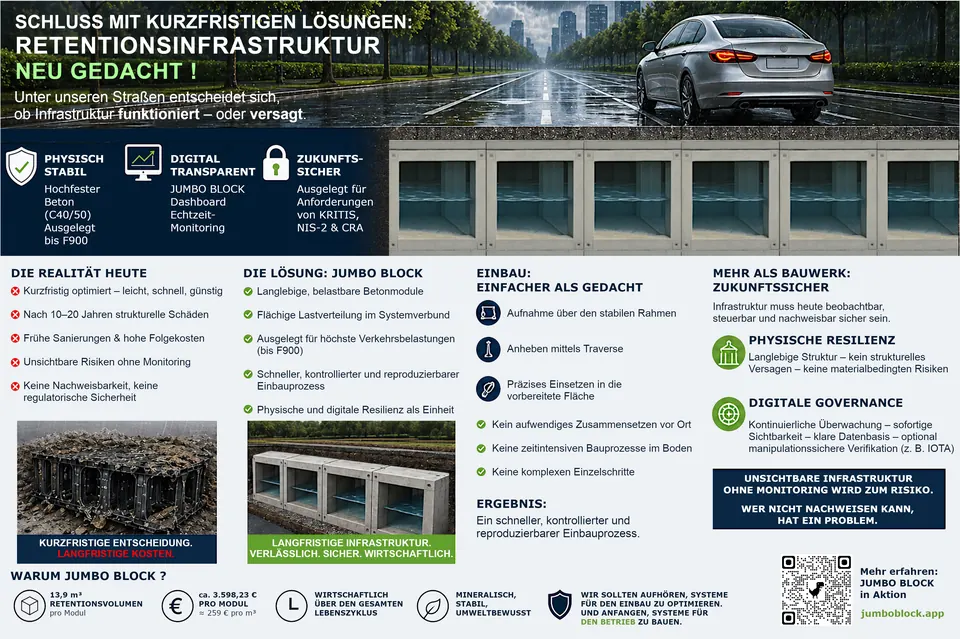
An end to short-term fixes:
Why retention infrastructure has to be rethought
What actually happens beneath our streets, car parks and industrial sites?
When rain falls, water has to be absorbed, stored and discharged in a controlled way.
For years, underground retention and infiltration systems have been installed for this purpose.
The standard: light, fast, cheap.
But this is exactly where the problem begins.
The reality: infrastructure built to wear out
Many of the systems used today are optimised for short-term efficiency:
- easy transport
- fast installation
- low initial costs
What is often ignored:
👉 Infrastructure is not a disposable product.
Systems that lose their structural stability after 10–20 years are not a solution –
they are a risk that has merely been pushed into the future.
A look at the reality outside
Anyone looking at the infrastructure of many cities and industrial sites today will recognise a recurring pattern:
- refurbishments that become necessary earlier than planned
- structures that do not reach their expected service life
- rising maintenance costs combined with falling reliability
That is no coincidence.
It is the result of decisions optimised for short-term efficiency –
not for long-term stability.
👉 What becomes visible above ground applies just as much below ground.
The difference:
Below the surface, these problems often remain undetected for a long time –
until they suddenly become critical.
And that is exactly why a simple but decisive question arises:
Why should we apply lower standards to invisible infrastructure than to visible infrastructure?
The blind spot: what happens in the ground has consequences
Underground systems are permanently exposed to:
- traffic loads
- settlement
- material ageing
When such systems fail, it happens invisibly – but not without consequences:
- loss of load-bearing capacity
- costly refurbishment
- potential environmental impact
And above all:
👉 Complete replacement becomes the only option.
A change of perspective: infrastructure as a decision for generations
Modern retention systems have to be thought of differently:
Not as a component – but as permanent infrastructure.
This is exactly where the JUMBO BLOCK® system comes in.
Instead of relying on short-lived materials, the system is based on:
- high-strength concrete (C40/50)
- load distribution across the whole system
- a clear design for extreme load scenarios
The result is not a product – but infrastructure
designed to last for decades.
Installation: easier than you think
A common argument against massive systems is:
“Too heavy, too much effort, too complicated.”
But this is exactly where the difference of modern system construction shows.
JUMBO BLOCK® modules are delivered to site prefabricated.
Assembly is not classic in-situ concrete work but a clearly defined lifting process:
- picked up by the sturdy frame
- lifted with a spreader beam
- set precisely into the prepared area
👉 No elaborate assembly on site
👉 no time-consuming construction processes in the ground
👉 no complex individual steps
The result:
A fast, controlled and reproducible installation process.
The difference lies not in the effort – but in the result.
Because while other systems are optimised for easy assembly,
JUMBO BLOCK® is designed for easy assembly and long-term stability.
Why this prevails technically
1. Load capacity instead of risk
Designed for traffic loads to EN 1991-2 (load model LM1).
Not as an individual component, but as a system working as a whole.
👉 No local weak points. No hidden failures.
2. Material that lasts
Concrete is a mineral building material.
- no fragmentation
- no microplastic residues
- no material weakening due to ageing
👉 The system stays what it is: stable.
3. Cost-effectiveness over the life cycle
One JUMBO BLOCK® module:
- 13.9 m³ retention volume
- approx. €3,598.23 per module
- ≈ €259 per m³
But the decisive question is not today’s price, but:
👉 How often will you have to invest again?
A system that has to be replaced is not a cheap system.
More than a structure: infrastructure in the context of new requirements
The requirements for infrastructure have changed fundamentally.
Today it is no longer only about load capacity or volume.
It is about:
- traceability
- operational safety
- digital monitoring
- clear responsibilities in operation
Current developments around KRITIS, NIS-2 and the Cyber Resilience Act make it clear:
👉 Infrastructure must not only work –
👉 it must be observable, controllable and demonstrably secure.
The difference: physical and digital resilience as one
This is exactly where a fundamental difference in the market arises.
While conventional systems are conceived purely physically,
JUMBO BLOCK® combines two levels:
1. Physical resilience
- durable, robust structure
- no structural failure in normal operation
- no material-related risks
2. Digital governance (JUMBO BLOCK Dashboard)
- continuous condition monitoring
- immediate visibility of deviations
- a clear data basis for operators and authorities
- optional tamper-proof verification (e.g. via IOTA)
Why this matters
The new regulatory requirements lead to a clear development:
👉 Invisible infrastructure without monitoring becomes a risk
Because without:
- data
- evidence
- condition information
there is:
- no reliable assessment
- no clean documentation
- no regulatory certainty
The logical consequence
The question is no longer:
Which system stores water?
But:
Which system meets the requirements of modern, regulated infrastructure?
JUMBO BLOCK® as the answer to this development
JUMBO BLOCK® combines:
- physical stability over decades
- digital transparency in operation
- verifiability towards authorities and operators
👉 and thus turns from a technical solution into an
integrated infrastructure system.
The decisive difference
It is not about concrete vs. plastic.
It is about:
👉 temporary solution vs. infrastructure
👉 replacement cycles vs. durability
👉 costs today vs. responsibility over decades
The uncomfortable truth
Easy installation is not a mark of quality.
It is an argument of convenience.
But infrastructure is not built for installation –
it is built for operation.
The next generation builds differently
Retention systems are not a by-product of construction planning.
They are a central part of modern infrastructure.
Whoever plans today is not deciding for one project –
but for the decades to come.
JUMBO BLOCK® stands for exactly this change of perspective:
- durable
- robust
- economically sensible across generations
- designed physically and digitally for future requirements