
Blog
Why Preparedness Pays Off for “Non-KRITIS” Facilities Too
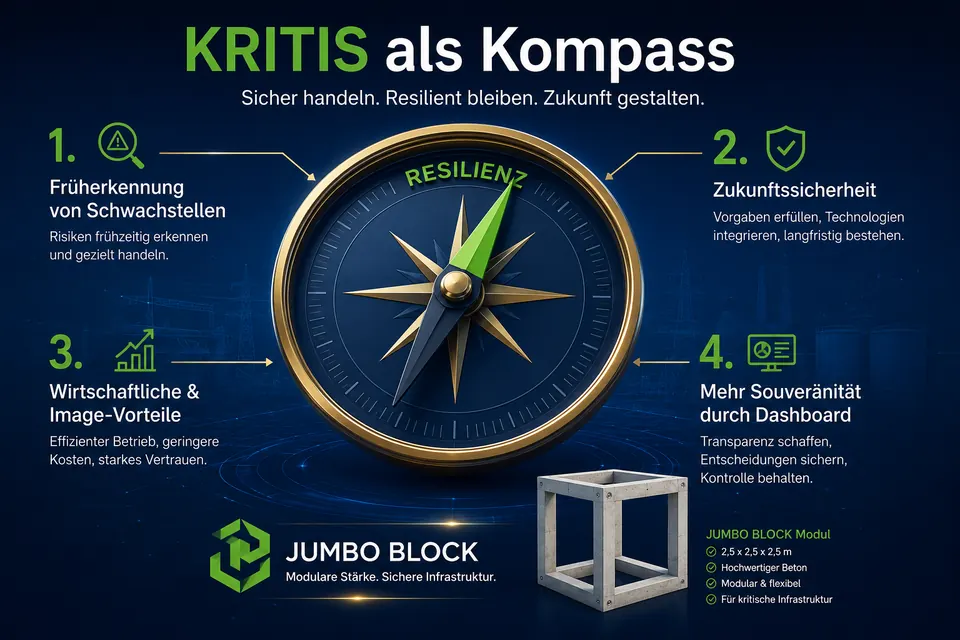
Recognising opportunities
Prevention is better than cure – this old principle is taking on new urgency in times of increasing extreme weather, cyber threats and regulatory requirements. The German KRITIS umbrella act sets high standards for the protection of critical infrastructure. But what does this mean for operators whose facilities do not (yet) exceed the strict thresholds? More than you might think at first glance.
KRITIS – not just a duty for the big players
The KRITIS umbrella act applies to operators of critical facilities – usually from a supply level of around 500,000 people. NIS-2 additionally covers numerous medium-sized and large entities in certain sectors, generally from 50 employees or €10 million in annual turnover. For many municipalities, smaller public utilities, industrial parks or decentralised facilities, their own wastewater treatment plant, stormwater retention system or local energy supply may nevertheless lie formally outside the direct scope.
That is no reason to sit back, though. On the contrary: KRITIS is an excellent compass for taking a critical look at your own resilience – even if you are not (yet) obliged to.
Three good reasons why the KRITIS perspective pays off now
1. Early detection of weak points
Anyone who checks their facilities against KRITIS benchmarks (risk analyses, physical protection, digital monitoring) discovers gaps before they become a problem. A heavy-rain event or a cyberattack on the controls of a pumping station affects small and large operators alike.
2. Future-proofing
Opening clauses for the federal states, supply-chain requirements from large partners and possible tightening of regulation make it likely that more and more facilities will come into focus. Those who aim for KRITIS level today are well positioned tomorrow – and avoid costly retrofits.
3. Economic and reputational benefits
Better resilience means fewer outages, greater operational reliability and a strong sustainability image. In stormwater management and sponge-city projects in particular, preparedness becomes a clear competitive advantage.
A practical example: intelligent stormwater retention
Modern systems such as JUMBO BLOCK show how the KRITIS idea can be put into practice. Heavy-duty, easy-to-maintain concrete modules combined with a NIS-2- and CRA-ready dashboard enable real-time monitoring of fill levels, weather data and system status. Tamper-proof data anchoring (including with IOTA) and clear dashboards not only support compliance with future obligations – they give operators more sovereignty and confidence every day.
For facilities that are not currently covered by KRITIS, too, this means: more overview, more security, more peace of mind.
From obligation to opportunity
KRITIS is far more than another bureaucratic hurdle. It is an invitation to make your own operations future-proof. Those who start making their facilities more resilient today not only protect themselves and live up to their responsibility – they make a real contribution to society's preparedness as a whole.
Prevention is better than cure.
Use the orientation that KRITIS provides, even if you are not yet formally affected. It pays off – for your facilities, your employees and the people who depend on secure infrastructure.
Would you like to make your facilities future-proof?
Contact us for a no-obligation consultation or a demo of the JUMBO BLOCK Dashboard.