
Blog
Why We Need to Rethink Stormwater Retention
A fundamental question
When it comes to stormwater retention, many municipalities and planning offices face a fundamental question: do we rely on large central basins or on decentralised underground systems? On classic concrete tanks or on modular plastic systems? On infiltration or on retention?
This kind of either-or thinking is understandable – but it is increasingly unsuited to the challenges we face today.
The limits of the classic approach
Heavy-rain events are becoming more frequent and more intense. At the same time, requirements for land efficiency, traffic loads, maintainability and regulatory resilience (think KRITIS and NIS-2) are rising.
Many proven systems are reaching their limits:
- Large open or underground basins need a lot of space and are often not feasible in densely built-up areas.
- Small decentralised plastic systems quickly reach economic and technical limits with high loads or large volumes.
- Pure infiltration solutions only work where the subsoil allows – and fail with extreme amounts of rainfall.
The result is often a compromise that is neither particularly economical nor particularly future-proof.
Why we need to combine today
Modern stormwater management strategies do not need new dogmas. They need the right combination of proven and new approaches. Instead of playing systems off against each other, we should complement them intelligently.
This is not about devaluing existing solutions. It is about starting where classic approaches reach their limits – and adding targeted solutions there.
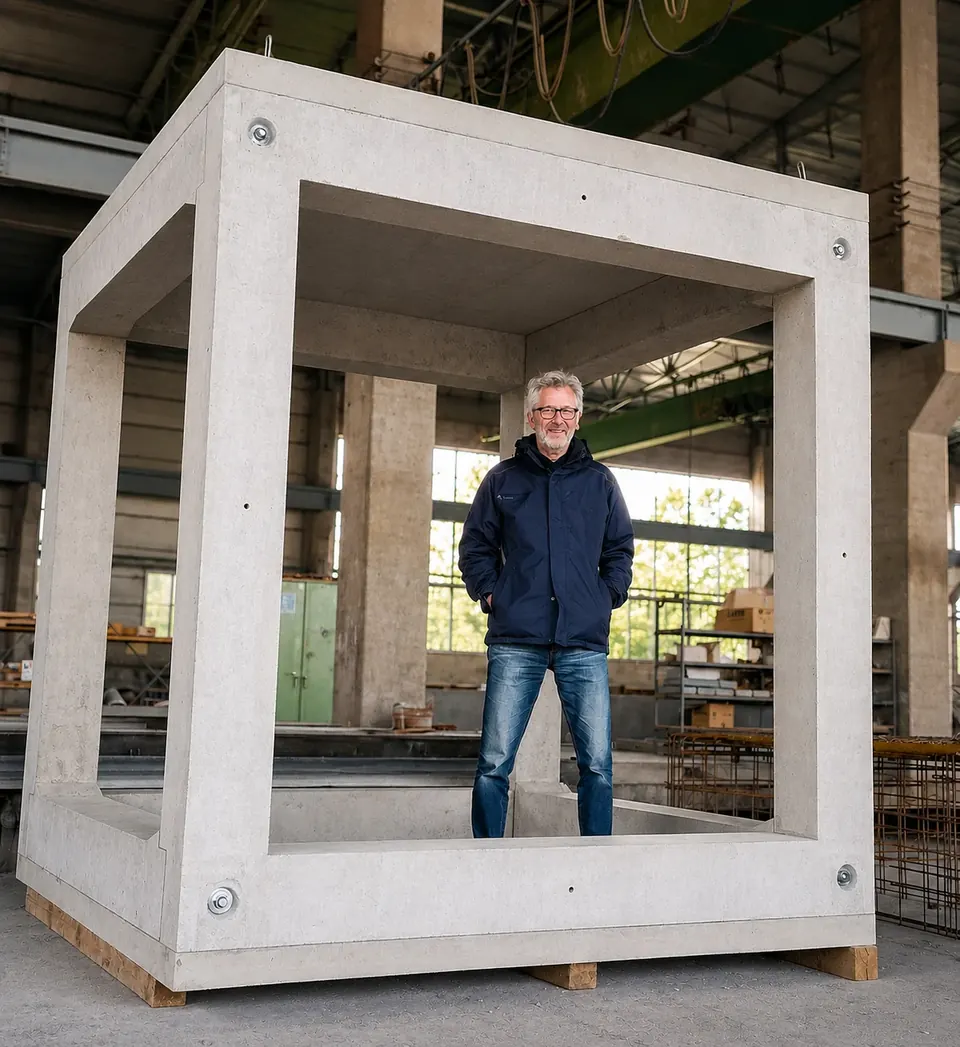
This is exactly where the strength of large-volume modular concrete systems lies. They enable large storage volumes beneath traffic areas, are extremely resilient and durable and – if designed accordingly – walk-in and maintainable. They can also serve as technical space in which utility lines are routed in a protected and accessible way.
Complement, don't displace
The key lies not in replacement but in intelligent complementation. A multifunctional underground system can be used where other solutions reach their capacity, load or maintainability limits. At the same time, proven decentralised or near-surface measures remain where they work well.
This ability to combine will become increasingly important. The demands on urban infrastructure are not becoming simpler – they are becoming more complex. Land is scarce, traffic loads are rising, and requirements for resilience and digital evidence are increasing.
Those who think only in classic categories today risk facing similar problems again in five or ten years.
The right solution for the right task
There is no single technology that solves every problem. There are, however, technologies that deliver significantly better results than others in certain situations. What matters is to assess these strengths realistically and to use systems where they can deliver the greatest benefit.
Instead of “either-or”, the question should be: how do we combine existing and new solutions so that they strengthen each other?
Learn more about the “complement, don't displace” philosophy and the concrete possibilities of large-volume modular systems here: Complement, don't displace