
Blog
Carbon footprint over 100 years: rainwater storage across its life cycle
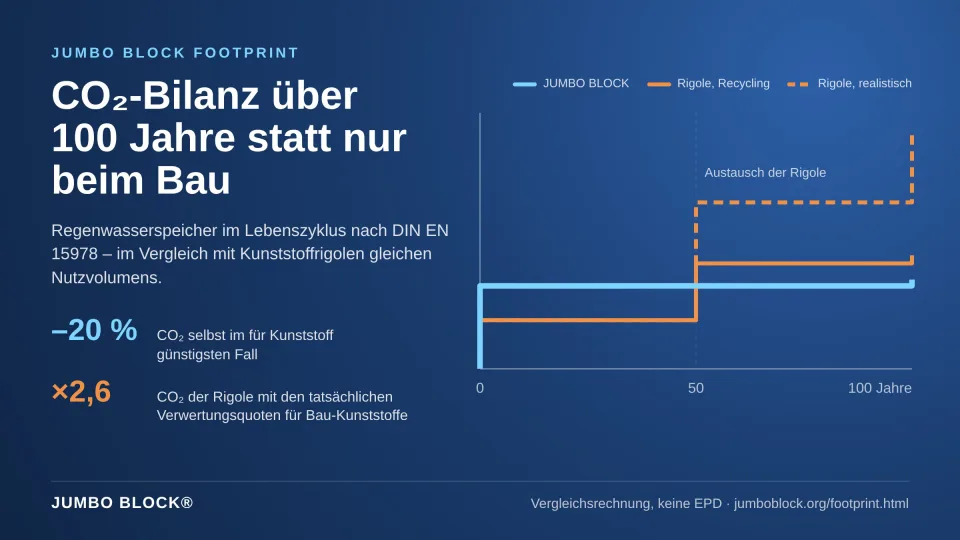
How much CO₂ does underground rainwater storage cause? The usual answer only looks at production. But a storage system stays in the ground for decades – and if it has to be replaced during that time, excavation, disposal, new production and installation happen a second time. With JUMBO BLOCK Footprint, we therefore assess the entire life cycle over 100 years.
What JUMBO BLOCK Footprint calculates
Footprint is a new program in the JUMBO BLOCK Engineering Suite. It takes the verified concrete and steel quantities of every component directly from the structural calculation and assesses the global warming potential (GWP) per DIN EN 15804 and DIN EN 15978:
- Production (A1–A3): concrete and reinforcing steel of modules, cover and side slabs
- Transport (A4): freely definable transport chain from the plant by truck, rail or inland waterway
- Installation (A5): excavation including soil cover
- Replacement (B4): every replacement within the study period
- End of life (C1–C4): deconstruction, transport and recovery
For comparison, Footprint calculates a polypropylene crate system with the same usable volume.
Deliberately conservative
A comparison is only as good as its assumptions. That is why all assumptions favour the plastic crate system:
- The crates are given the highest service life stated by any manufacturer.
- They are calculated with the lightest system on the market, without liner and geotextile.
- In the main result, they are fully recycled at the end of life – the most favourable case for them.
- Credits beyond the system boundary (module D) are not offset but declared separately.
- The CO₂ uptake of concrete through carbonation is not taken into account.
The result
For production alone, plastic comes out ahead – an honest assessment says so. Over 100 years, the picture reverses because the crates have to be replaced within that period:
- Even in the case most favourable to plastic, JUMBO BLOCK causes around one fifth less CO₂.
- With the actual recovery rates for construction plastic waste in Germany, the crates cause more than two and a half times as much.
- Rail transport from the plant improves the JUMBO BLOCK balance further.
The difference does not arise during construction but over the service life: a structure that does not need replacing causes excavation, disposal and new production only once.
What happens at the end of life
JUMBO BLOCK is made of reinforced concrete. On deconstruction, the concrete is processed into recycled aggregate and the reinforcing steel is fully recycled. In practice, plastic crates are mostly incinerated after removal: according to the material flow study on plastics in Germany 2025, only around one fifth of plastic waste from construction is mechanically recycled. Footprint therefore shows three scenarios – recycling, the statistical mix and incineration.
Traceable to the source
Every characteristic value is shown in the report with source, version and validity: environmental product declarations of the InformationsZentrum Beton, datasets from the ÖKOBAUDAT, emission factors of the German Environment Agency and the recovery rates from Conversio. An input and a result checksum (SHA-256) ensure that printout and project state belong together. The calculation is a comparative calculation per DIN EN 15978 based on environmental product declarations – not an environmental product declaration (EPD) in its own right.
For planning and tendering
More and more tenders evaluate life-cycle costs or greenhouse gas emissions. Footprint provides the value in kg CO₂ equivalent per m³ of usable volume – directly from the planning and structural data of your project.
We prepare the carbon assessment on request from your project.dbm: JUMBO BLOCK Footprint.