
Blog
Digital Resilience Starts Long Before an Emergency
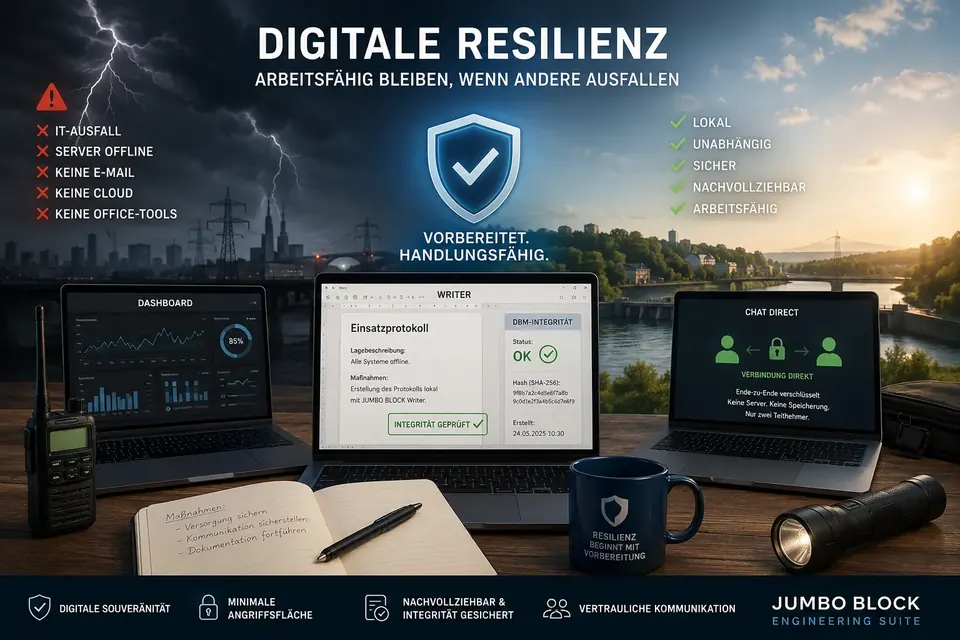
When people talk about critical infrastructure, many think first of power grids, waterworks or data centres. But critical infrastructure does not consist of technology alone. It also consists of people who have to make decisions, exchange information and produce documents.
What happens if exactly this ability to work is suddenly lost?
A cyberattack, a serious IT outage or damaged infrastructure can mean that familiar systems are no longer available. Email does not work, central servers cannot be reached and conventional office software can no longer be used.
So the real question is not:
How do we prevent every outage?
But:
How do we stay able to act anyway?
Resilience means staying able to work
Resilience does not begin only when an IT infrastructure is restored. It begins the moment an organisation can keep working despite restrictions.
A notice has to be issued.
An operations log has to be documented.
A technical instruction has to be written.
A decision has to be recorded in a traceable way.
It is precisely in such situations that simple, independent tools suddenly become valuable.
Less complexity often means more security
Over the past months we have consistently developed our platform around one idea:
As few dependencies as possible.
Local applications.
No cloud as a prerequisite.
No unnecessary data storage.
Small programs with clearly defined tasks.
Each application does exactly its job – no more and no less.
Three new applications – one common goal
This idea has given rise to three new tools that perform different tasks but follow the same philosophy.
Dashboard
The dashboard supports traceable recording and evaluation of operating data. It helps to present technical states transparently and to document developments.
Writer
The JUMBO BLOCK Writer lets you create documents locally – independently of cloud services or central office systems.
Documents can be exported as PDF. They can also be saved in DBM format, which contains an integrity proof so that it can later be checked whether a document still matches the original unchanged. This is particularly important in the event of an attack.
Chat Direct
Chat Direct takes a different approach from conventional messengers.
No user accounts.
No database.
No conversation history.
No central collection of personal communication data.
The aim is the smallest possible attack surface combined with confidential communication between exactly two participants.
Hopefully never needed
These applications were not developed because we assume that every organisation regularly ends up in crisis situations.
Quite the opposite.
They were developed so that they already exist before they are needed.
Nobody builds a fire station because they want a fire.
Nobody installs emergency generators because they hope for a power cut.
And nobody develops resilient digital tools because they want IT systems to fail.
You develop them because the ability to work must be maintained even when the exceptional case occurs.
Digital resilience is not a product
It is an attitude.
It means designing systems so that they remain traceable, manageable and independent.
Not every challenge can be prevented.
But a great deal can be prepared so that organisations can keep working even in difficult situations.