
Blog
What Does Trustworthy Infrastructure Mean in 2026?
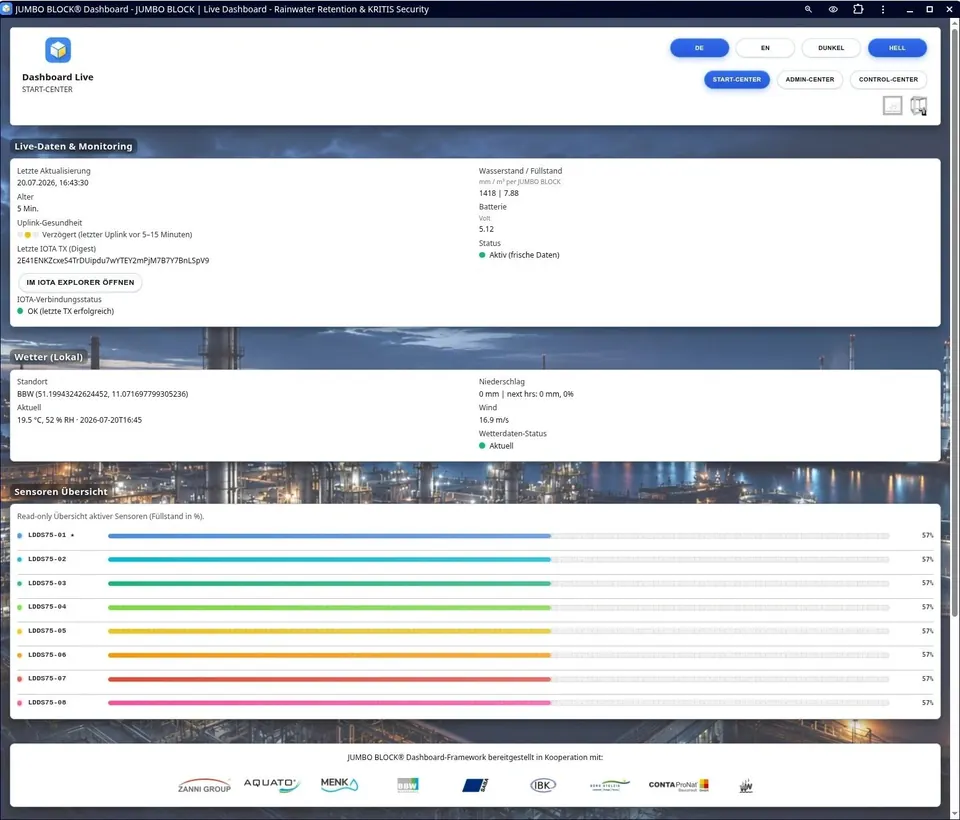
Dashboard · START-CENTER
Trust begins with verified data.
Floods, outages or damage rarely announce themselves.
That is why modern infrastructure begins with reliable information.
Our START-CENTER shows live data from the installation, weather information and the current operating status. In addition, important events can be cryptographically anchored on the IOTA mainnet.
Not because blockchain sounds modern.
But because trust has to be verifiable.
Dashboard · ADMIN-CENTER
Infrastructure does not end with the structure.
A retention system must not only store water.
It has to be monitored, maintained and documented.
The ADMIN-CENTER brings together system status, sensors, backups, blockchain connection and maintenance in one interface.
Because resilience does not arise only in an emergency, but in day-to-day operation.
Dashboard · ADMIN-CENTER
A system is only as good as its evidence.
Measured values alone are not enough.
What matters is that it remains traceable later
- when
- which data
- under which conditions
- were recorded.
That is why audit, history and cryptographic verification belong together.
Evidence instead of claims.
Dashboard · ADMIN-CENTER
Fail-safety begins before the failure.
- Backups.
- Sensor management.
- Recovery.
- Service monitoring.
All things nobody talks about.
Until they are needed.
Then they decide between minutes and days of downtime.
Dashboard · SETUP-CENTER
Good infrastructure must be easy to configure.
Sensors.
Locations.
Audit.
Blockchain.
Everything is set up via one interface.
No programming.
No special software.
No complicated procedures.
Technology must support people – not the other way round.
Dashboard · SETUP-CENTER
Transparency is a gain in security.
Who operates an installation?
Where is it located?
What audit data exists?
Which events have been documented?
Transparency creates trust – internally as well as towards authorities, insurers and operators.
Dashboard · SETUP-CENTER
Documentation does not end with construction.
Infrastructure lives for decades (80–120 years).
That is why operating data is continuously archived and documented traceably.
Not for statistics.
But so that decisions remain verifiable years later.
Dashboard · CONTROL-CENTER
AI does not decide.
People decide.
The system assesses.
Sensors provide data.
The dashboard recognises situations.
It suggests measures.
Responsibility remains with the operator.
This is exactly how critical infrastructure should work.
Dashboard · CONTROL-CENTER
KRITIS is only the beginning.
- Property.
- Companies.
- Municipalities.
- Industry.
- Logistics.
Every infrastructure deserves traceable data, secure documentation and transparent decisions.
Because in the end, it is not about KRITIS.
It is about trust.
Trust in technology.
Trust in decisions.
Trust in the protection of our infrastructure.
Infrastructure is changing.
It used to be enough to build structures that were stable.
Today they must also withstand extreme weather, be operated traceably, be monitored digitally and be documented over the long term.
KRITIS and NIS-2 make this development particularly visible.
But in fact it affects far more:
- Municipalities.
- Public utilities.
- Airports.
- Industrial plants.
- Logistics centres.
- Data centres.
- Military infrastructure.
- Transport routes.
- Hospitals.
- And ultimately every operator who has to reliably protect people, assets or critical processes.
The decisive question is therefore no longer:
“Do we need digital infrastructure?”
But:
“How do we create infrastructure that we can still trust in ten or twenty years?”
That is exactly what JUMBO BLOCK was developed for.
Not as a single product.
But as a continuous system of planning, structure, monitoring, audit and traceable documentation.