
Blog
From Infrastructure Risk to Verifiable Resilience
How JUMBO BLOCK® helps cities avoid the liability trap of modern infrastructure rules
Cities around the world face a growing challenge.
Urban spaces are increasingly dominated by asphalt and concrete. At the same time, extreme heavy-rain events are increasing in many regions and occur more frequently and more intensely. When large amounts of water hit sealed surfaces within a short time, existing drainage systems are often overwhelmed.
Flooded streets, damaged infrastructure and rising financial losses are the visible consequences.
But behind this physical damage lies another, often underestimated risk.
A governance and liability problem.
Municipalities, infrastructure operators and public utilities increasingly have to prove that they actively monitor, assess and document the risks in their systems. Rules such as NIS-2 or the German KRITIS frameworks increase the pressure on operators not only to run infrastructure but also to document its condition and behaviour traceably.
Put simply:
it is no longer enough to build infrastructure.
Operators also have to be able to prove that they operate it responsibly.
The emerging liability gap in infrastructure
For a long time, traditional urban infrastructure was designed to drain water away as quickly as possible. Streets, sewers and drainage systems were planned for average rainfall events.
But the combination of sealed surfaces and extreme rainfall events increasingly leads to situations in which these systems reach their capacity limits.
When infrastructure fails, a central question arises:
Could the operator have foreseen or mitigated the risk?
If this question cannot be answered clearly, a liability gap arises.
Many existing infrastructures today lack three decisive capabilities:
• continuous monitoring
• transparent operational documentation
• verifiable data records
Without these elements, operators often cannot show traceably how a system behaved during a critical event.
From passive infrastructure to monitored systems
The JUMBO BLOCK® approach looks at the problem from a different perspective.
Instead of relying solely on drainage, the system turns sealed urban surfaces into underground retention spaces.
Installed beneath streets, squares or other sealed surfaces, JUMBO BLOCK modules create large underground storage volumes that can take in considerable amounts of water during intense rainfall.
But physical storage is only part of the solution.
Just as important is the ability to observe, analyse and document what happens within the system.
This is where the digital infrastructure component comes in.
The JUMBO BLOCK® digital infrastructure platform
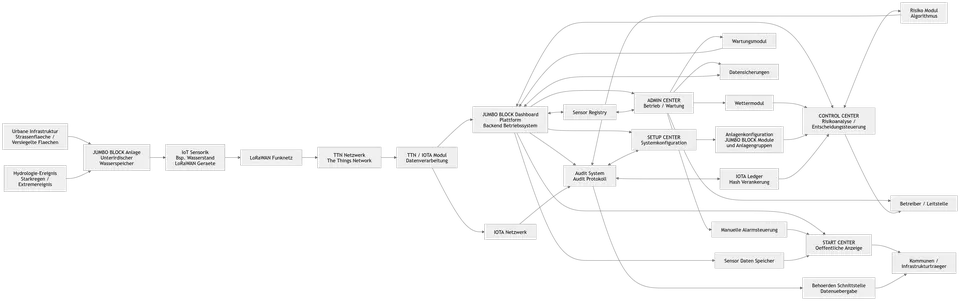
The JUMBO BLOCK platform connects physical infrastructure with a monitoring and documentation system made up of several components:
• IoT sensors for water-level measurement
• LoRaWAN communication networks
• the JUMBO BLOCK Dashboard platform
• automated risk analysis
• an infrastructure audit system
• optional IOTA-based data anchoring
Together, these components turn passive infrastructure into a monitored resilience system.
Sensor data is transmitted via LoRaWAN networks to the JUMBO BLOCK Dashboard, where operators can observe water levels, system behaviour and infrastructure states in real time.
Operating states and decisions can be documented in audit logs.
This data can optionally be anchored in a distributed ledger, forming tamper-proof evidence of how the infrastructure was operated.
JUMBO BLOCK® as infrastructure – the dashboard as an optional extension
The JUMBO BLOCK Dashboard is not a stand-alone product but an optional part of a JUMBO BLOCK system.
The core of the solution is the physical infrastructure:
modular underground retention spaces that can be installed beneath streets, squares or other sealed surfaces and take in large amounts of rainwater.
The dashboard adds a digital layer for monitoring, analysis and documentation to this infrastructure.
Depending on project requirements, a JUMBO BLOCK system can therefore be:
• operated purely as a physical water retention solution
• monitored with sensors
• or operated with full digital integration
A live demonstration of the dashboard interface is available here:
The demo shows by way of example how sensor values, installation states and risk analyses can be displayed within the system.
Monitoring, decisions and evidence
This architecture creates something that classic infrastructure often cannot provide:
a complete chain of operational evidence.
Monitoring
→ risk analysis
→ operational decisions
→ audit documentation
→ verifiable data anchoring
For operators, this means they can not only respond to events but also prove how a system behaved and which decisions were made.
This capability is becoming increasingly important in modern infrastructure management.
Infrastructure that can explain itself
In the architecture of the JUMBO BLOCK digital infrastructure platform, urban infrastructure, sensor networks, monitoring systems and audit mechanisms work together to create a transparent and traceable infrastructure environment.
The basic idea behind it is simple:
infrastructure should not only work.
It should also be able to explain itself.
A new model of resilient urban infrastructure
As cities adapt their infrastructure to changing environmental conditions and rising regulatory requirements, the underlying systems will evolve too.
Future infrastructure will probably combine three elements:
physical resilience
digital monitoring
verifiable operating data
JUMBO BLOCK® stands for an approach in which these elements are considered together from the outset.
The result is not just flood protection.
It is a form of transparent, monitored and traceable infrastructure.
Conclusion
Urban infrastructure is entering a new phase.
In future, cities will be judged not only by what they build but also by how responsibly they operate their systems.
Technologies that combine physical resilience with digital transparency will play a central role in this.
JUMBO BLOCK® is a step towards infrastructure that is not only more robust – but also observable, documentable and explainable.