
Blog
JB-ANCHOR-V1: every reading verifiable on the IOTA mainnet
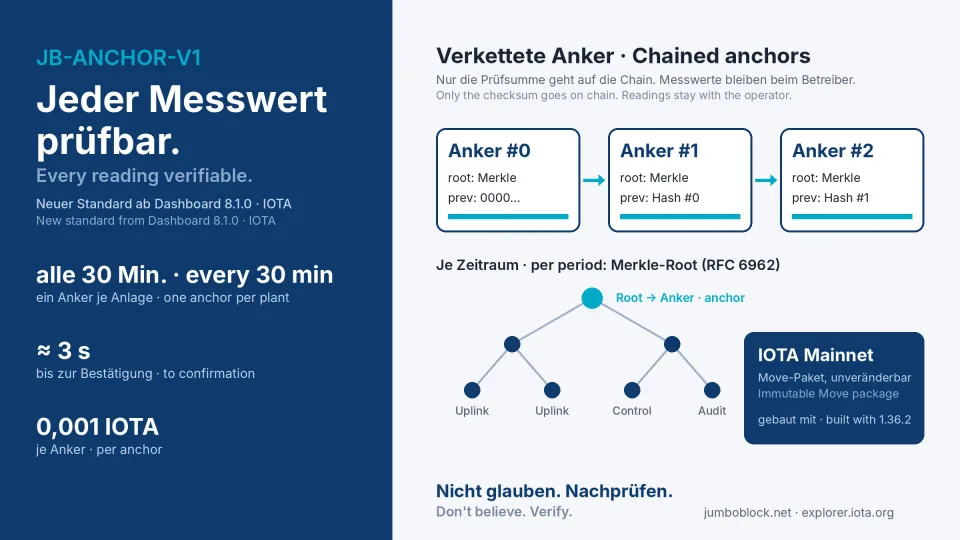
In short: Since 21 November 2026, JB-ANCHOR-V1 has been the new standard for all JUMBO BLOCK Dashboards. From version 8.1.0, every dashboard anchors the measurement data of its plant on the IOTA mainnet every 30 minutes. Only a checksum goes on chain. The readings stay with the operator. Any later change becomes visible, and anyone can check this for themselves.
Trust is good. Verification is better.
A fill level from last night, an alarm during the last heavy rain, a decision in the Control Center: such data only counts if you can later prove it has not been changed. A database of your own is not enough. Whoever runs it can also change it. Auditors would simply have to take the operator's word for it.
That is exactly what we want to avoid. Water management plants in Germany have been covered by the KRITIS umbrella act since 17 March 2026 and by the NIS-2 implementation act since 6 December 2025. Both call for traceable, reliable evidence. That is why every plant gets an independent, public timestamp that nobody can change afterwards, not even us.
How JB-ANCHOR-V1 works
JB-ANCHOR-V1 is our own procedure. It uses only open standards, so anyone can verify it without JUMBO BLOCK software.
- Store: Every sensor uplink is stored locally right away, in a fixed, unambiguous form according to RFC 8785. Control Center decisions and the current state of the audit chain are added.
- Summarise: On the hour and half hour, all records of the period are condensed into a single checksum, a Merkle root according to RFC 6962. The same method secures the internet's Certificate Transparency logs.
- Chain: Every anchor carries the checksum of its predecessor. If an anchor is missing, removed or inserted later, the chain visibly breaks.
- Anchor: A small Move program on IOTA writes the anchor as an event to the mainnet ledger. Confirmation arrives after about 3 seconds.
The program was published and made immutable in the very transaction that created it. There was never a moment when it could be changed. Nobody can touch its logic any more.
What is on chain and what is not
Every 30 minutes, only a few numbers reach IOTA: a checksum, the anchor number, the period, the number of records and a pseudonymous plant identifier. Readings, coordinates, names and notes never leave the operator's device.
For critical infrastructure this is essential. Plant and sensor identifiers are random values without meaning. No location can be derived from them. Every plant publishes its own program from its own wallet and starts its chain at zero. There is no common point that could link plants of different operators.
The figures
- JB-ANCHOR-V1 test series: 48 hours on the IOTA mainnet before rollout, 95 anchors, not a single failed attempt
- New standard: since 21 November 2026 with Dashboard 8.1.0 "Brilon", for every JUMBO BLOCK Dashboard
- Confirmation: about 3 seconds per anchor
- Cost: 0.001 IOTA per anchor, about 17.5 IOTA per plant and year
- Basis: built with IOTA 1.36.2
A restart or power cut does not break the chain either. On an orderly shutdown the current period is closed and anchored at once. After a hard failure it is anchored on the next start and logged as such.
Check it yourself
You don't have to take our word for anything. Everything is public:
- Anchor number 0 in the IOTA Explorer
- The wallet of our dashboard at jumboblock.net: a new anchor arrives every 30 minutes, around the clock.
- Publication of the program, made immutable in the same transaction
- jumboblock.net shows the latest anchor live, with number, time and a link to the explorer.
If an operator has to prove a single reading to an authority or insurer, they hand over just three things: the record, the audit path and the anchor transaction. All other readings stay with them.
What an anchor proves and what it does not
An anchor proves that the data existed in exactly this form at that time and has not been changed since. It does not prove that a sensor measures correctly. That is what calibration and maintenance are for.
Why IOTA?
Low cost, fast confirmation and a lean Move program. Even so, JB-ANCHOR-V1 is deliberately not tied to IOTA. The checksums follow open standards. If needed, the procedure could continue on another chain. Andreas Zanni explains in detail why we chose IOTA rather than Ethereum in his interview with Kryptorevolution (in German).
Concrete and data, both load-bearing
Our modules hold back heavy rain. The JUMBO BLOCK Dashboard makes sure that, years later, you can still prove what happened in the plant. For us the two belong together, because critical infrastructure needs both: a structure that holds and data you don't have to trust blindly.
Don't believe. Verify.
Questions about anchoring or monitoring your plant? Write to us at mail@jumboblock.de or use our contact page.