
Blog
Store rainwater instead of draining it
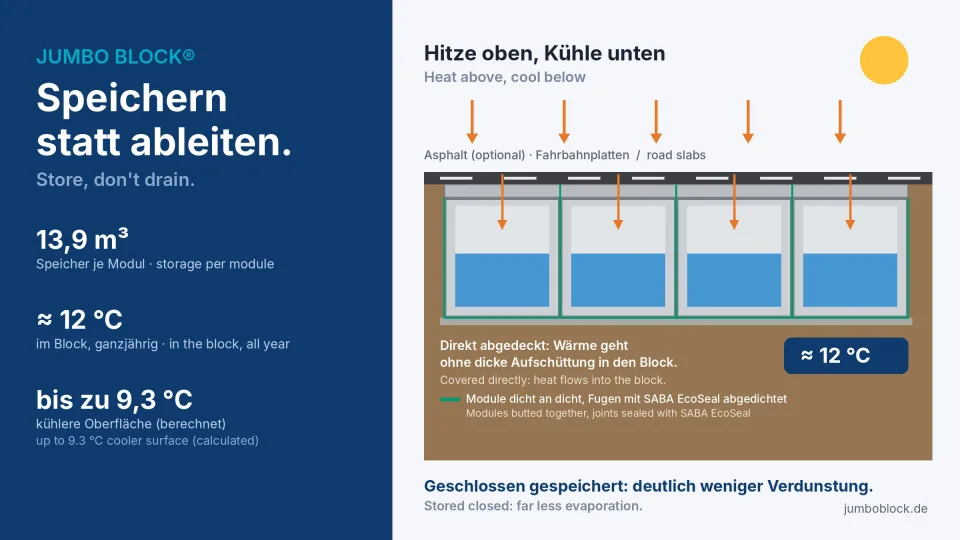
In short: We drain rainwater away and complain about water shortages at the same time. Beneath roads and car parks that are being built or renewed anyway, closed storage tanks can hold rainwater back without it evaporating. Installed deep in the ground, the storage also cools the surface above it, by up to 9.3 °C according to our calculations.
When lakes disappear
The Uckermark in north-east Brandenburg looks like intact nature at first glance. Yet it is running out of water. The German daily Tagesspiegel reports that hundreds of small ponds, bogs and field hollows have disappeared there in the past ten years alone. A freshwater ecologist counts 21 of the region's former 219 lakes that have vanished since 1992.
The causes are many, and no single technology will fix them. But the development raises a question that reaches far beyond Brandenburg: are we handling rainwater the right way?
Built to get rid of water
For decades our infrastructure has been designed to drain rainwater away as quickly as possible. From roofs, roads and squares it flows into the sewer and on into the nearest river. What protects us during heavy rain is missing in the next dry spell.
On top of that, wherever water stands in the open, in shallow basins or swales, a large share evaporates on hot days before it can be used. Small retention and infiltration measures are important and right. Given the scale of the task, however, we also need large, closed storage systems.
Store where we build anyway
Roads, car parks and paths are built, renewed or dug up anyway. That is exactly where storage can be created, invisible and without taking up extra land. The surface above remains road, car park or green space.
- Large volume: every JUMBO BLOCK module stores 13.9 m³, around 2,224 litres per square metre of footprint.
- Modular: storage capacity grows with the number of modules and can be extended in any direction.
- Trafficable: designed for traffic loads to EN 1991-2, load model LM1.
- Closed: modules butted together, all joints sealed with SABA EcoSeal, shielded from the sun, with significantly reduced evaporation.
- Durable: design service life of 80 to 120 years to EN 1990, walk-in and maintainable.
Depending on the need, the installation holds water back and releases it at a throttled rate, stores it for irrigation and operations, or lets it infiltrate. More on our page on stormwater retention.
Cool ground, cooler surface
Because it is installed deep in the ground, the block stays at a fairly constant temperature of around 12 °C all year round. On hot days it absorbs heat from the surface above. The higher the outside temperature, the greater the heat transfer. Simple physics.
The build-up is what makes it work: the modules are covered directly with road slabs, with a layer of asphalt on top if required. A thick layer of fill, by contrast, would considerably reduce the cooling effect.
For the surface above the installation, this results in cooling of up to 9.3 °C. That is a calculated value from our Temp program in the Engineering Suite, not a measurement. But it shows that storage beneath a road does more than hold water: it also works locally against heat.
Measurable and verifiable
Storage only helps if you know what is happening inside it. Sensors measure the fill level, and the JUMBO BLOCK Dashboard shows it in real time. Every 30 minutes, a checksum of the data is anchored on IOTA. This makes it possible to prove, even years later, how much water was held back and stored. Our post on JB-ANCHOR-V1 explains how it works.
A complement, not a replacement
Underground storage replaces neither natural water bodies nor the rewetting of bogs and landscapes. It complements these measures wherever we build infrastructure anyway, above all in towns and municipalities, along roads and on commercial sites.
Perhaps we need to stop treating rainwater as a disposal problem and start treating it as a resource for the future. Because water we drain away unused or let evaporate today could be missing tomorrow.
No reason to panic. We have solutions.
Further reading (in German): "Die Gewässer dort sind verloren": the Uckermark is drying out (Tagesspiegel Plus, 22 November 2026).
Planning retention, storage or infiltration? Write to us at mail@jumboblock.de or use our contact page.