
Blog
The Air Conditioning Lies Beneath the Street
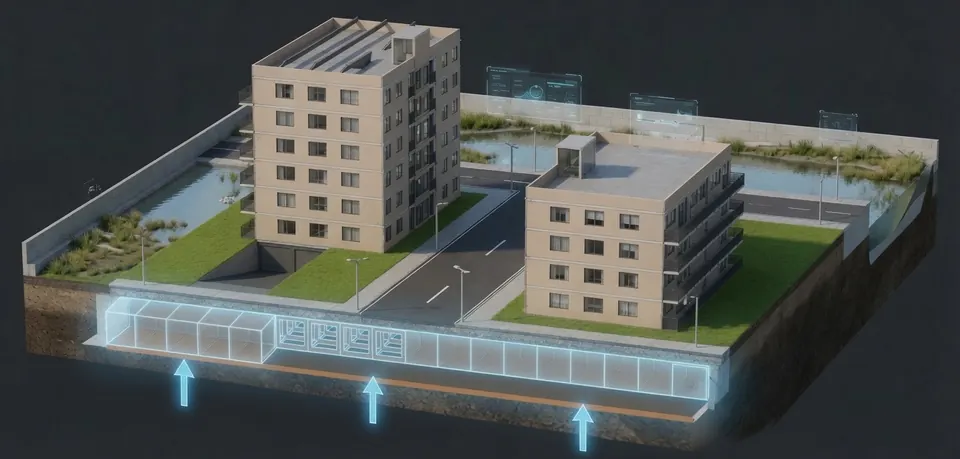
How smart concrete modules can protect our cities from heat
From sealed heat island to a city that feels good – a system protected by registered rights turns streets into active, weather-independent coolers.
When the city becomes a heat island
Imagine this: it is 38 degrees. You are cycling or walking along a narrow inner-city street. The asphalt radiates heat like a patio heater, the air shimmers and you can feel the heat right up to the backs of your knees. Many people – especially older people, children or the chronically ill – suffer in such conditions.
On hot days, temperatures in German cities can be 4–6 °C (sometimes up to 10 °C) higher than in the surrounding countryside. This is called the urban heat island effect. Asphalt and concrete absorb up to 95% of solar radiation and store the heat for days.
Classic sponge-city concepts (more greenery, desealed surfaces, local water storage) can help – but they reach their limits in densely built inner cities. The streets remain sealed and hot. This is exactly where an innovative system protected by registered rights comes in, turning the streets themselves into air conditioning – underground, and effective even when the store is largely empty.
The problem: asphalt as a heat store
At an air temperature of 38 °C, asphalt and concrete surfaces can easily reach 55–70 °C. This heat is stored during the day and released again at night – the city hardly cools down. Cyclists and pedestrians are particularly affected: they move directly above the hot surface and have no protective car body.
Surface measures alone are often not enough. What is missing is a solution that works beneath the surfaces people drive and walk on – without changing the surface.
The solution: JUMBO BLOCK – the underground climate effect
The JUMBO BLOCK system (developed by ZANNI GROUP) consists of massive but hollow concrete modules (standard size 2.5 × 2.5 × 2.5 m). Each module offers 13.9 m³ of net void volume. The modules are installed in a single layer beneath roads, cycle paths and footpaths – heavy-duty (also for heavy traffic, traffic load LM1 to EN 1991-2), easy to maintain and walk-in.
Think of the module as a huge underground pond with a built-in fan: it stores water, lets it infiltrate and at the same time allows air exchange. And it keeps cooling even when the void is largely dry.
How does the cooling work?
Science explained simply
Important first: cooling works in both states – wet and dry. In the wet state (after rain) it is particularly strong thanks to evaporation. In the dry state (after a long hot spell), the concrete mass, air circulation and heat conduction into the ground take over.
The system is weather-robust and needs no energy.
1. Thermal buffering (the big heat battery)
Water has an enormous heat capacity. 13.9 m³ of water can absorb up to approx. 16 kWh of heat per degree of temperature rise. In addition, the massive concrete itself has a high heat-storage capacity.
2. Evaporative cooling (like a wet towel in the sun)
When water evaporates in the voids or through permeable surface layers, it binds large amounts of heat. This noticeably cools the surroundings.
3. Heat conduction into the cool subsoil
At a depth of 2.5–2.8 m, Central Europe has relatively stable temperatures of around 8–12 °C. The modules conduct excess heat into this cooler ground.
4. Air circulation from below (the invisible breeze)
Through the open voids and permeable layers, cooler, moister air can rise from below. This lowers the temperature directly above the carriageway and on cycle paths and footpaths.
A concrete example: a street becomes a comfort zone
Let us take a typical inner-city section:
two traffic lanes + a cycle lane + footpaths on both sides (approx. 12 m wide). With 100 modules (each with 13.9 m³ of net void), a section approx. 50–60 m long is equipped.
Result for cyclists and pedestrians: less radiant heat from below, a cooler layer of air near the ground and a noticeably lower perceived temperature. Walks and bike rides become more pleasant and healthier, even on 38 °C days. The paths remain usable for longer – a real gain for active mobility in the city.
Why this is particularly interesting for municipalities
Multiple benefits on one area: no additional space needed at the surface.
Weather-robust: cooling and water management also work after dry periods.
Integrated infrastructure: municipal utility lines (water, wastewater) as well as digital structures (sensors, cables) can be integrated into the walk-in voids. Everything remains accessible and can be inspected and maintained without tearing up the road.
Cost efficiency: single-layer installation keeps costs manageable. In the long term, the city saves through lower heat-related health costs and a higher quality of life.
Resilience & security: the systems are heavy-duty, KRITIS-, NIS-2- and CRA-ready and can also be equipped with digital monitoring.
Achieving climate goals: a contribution to heat action plans, sponge-city strategies and adaptation to global warming.
Citizen satisfaction: a city where people enjoy walking or cycling even in the heat becomes more attractive – for residents, visitors and businesses.
Science meets everyday life – and the future
The physical principles (heat capacity, evaporation, heat conduction, convection) have long been known and well researched. The JUMBO BLOCK system combines these principles in a well-thought-out way and has been developed for practical use beneath traffic areas.
Combined with classic measures (trees, green roofs, light-coloured surfaces, desealed areas), a strong overall system emerges. The street is no longer the problem but part of the solution – even when the store is empty.
Conclusion: from heat island to a city that feels good
At a time when heatwaves are becoming more frequent and more intense, we need solutions that go below the surface and are weather-robust. The JUMBO BLOCK system shows how sealed streets can become active, permanent air conditioning – scientifically sound, technically feasible and noticeable for everyone.
Municipalities that invest in such intelligent infrastructure now create not only cooler but also more liveable cities. For cyclists, pedestrians, families and everyone who wants to enjoy their city again.
Sources & further information
– Urban heat island effect: JRC & Copernicus data (cities 4–10 °C warmer)
– Physical principles: specific heat capacity of water, latent heat of evaporation, Fourier's law of heat conduction
– Technical details: official information on the JUMBO BLOCK system (jumboblock.de / ZANNI GROUP)
Note: this document is intended for information and discussion. All performance figures are to be understood as “up to” values and depend on local conditions, design and operating state. The JUMBO BLOCK system is protected by registered rights and is currently being implemented in projects.